by Matthew Norton
The ocean has many features, but one of its most defining is how absolutely massive it is, covering around 70% of the Earth’s surface and making up 97% of the planet’s water supply. Some of the longest known animal migrations would not be possible without this great vastness, yet there are species who keep to a much smaller geographic range, despite being undoubtedly strong swimmers. Sometimes, the clue is even in the name, as is the case with Cape fur seals, who don’t typically venture more than a 100 miles away from the shores of South Africa and Namibia. Assuming their needs are comfortably met, why travel any further?

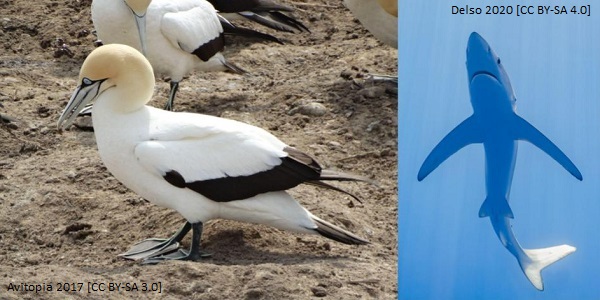
Their diet often consists of small fish, crabs, cephalopods and the occasional seabird, such as a fledgling cape gannet attempting their maiden flight. That’s not to say they exploit more unusual prey if the opportunity presents itself. Back in 2012, they were even documented catching and dining on blue sharks off the coast of Cape Point, South Africa. A gutsy move, considering how they themselves are targeted by great white sharks, of which there is usually a well-known abundance in those waters.
Naturally, the cape fur seal is well adapted for both catching tricky prey and dodging formidable predators. For example, their limb bones are almost fully withdrawn into their body for fast and effective swimming while their large eyes offer good visibility head on and at the sides, useful against hunters who need the element of surprise. And should they need to make a quick getaway out of the water, they have ridges in the soles of their flippers that make it easier to clamber up wet and slippery rocks. This added grip might also prove useful for hauling out onto the beach, where they can breed and pass on their survivalist genes to the next generation?
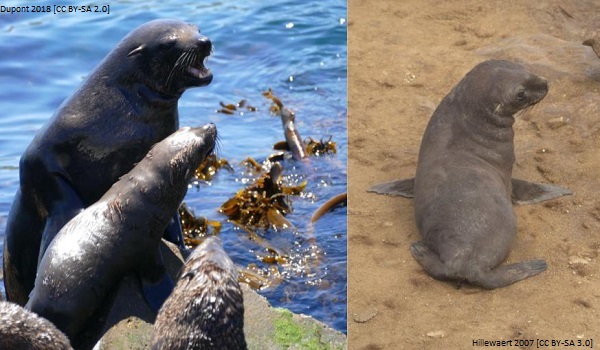
The males make landfall first, usually around mid-October, ready to use their big, blubbery mass to establish breeding colonies. They may hope for it to be a peaceful and civilised process, but more likely than not they will have to use overwhelming size and threatening displays to warn away potential rivals. And if this doesn’t do the trick, then the two bulls will get violent and use their bulk and their bite to try and force each other into submission.
By early November, the females start arriving on those same beaches, many of whom will be carrying babies that were conceived during the previous breeding season. They too, may have to compete among themselves for their preferred space within a bull’s given territory. And that’s assuming the bulls have finished among themselves prior to their arrival. But if all goes well, the pregnant females will give birth within a couple of days and then mate again several days after that.

Pretty standard so far for any given species of seal or fur seal. But across an ocean, the Indian Ocean to be specific, there is the Australian fur seal, a species that looks and behaves in almost exactly the same way as the cape fur seal. This is no coincidence either, because they are so closely related that they’re actually considered to be two subspecies of the Brown fur seal. But if they go generation to generation without meeting and cross breeding then their genes will grow more and more different from each other over time and, eventually, they will become two different species in their own right. This is a process called speciation.

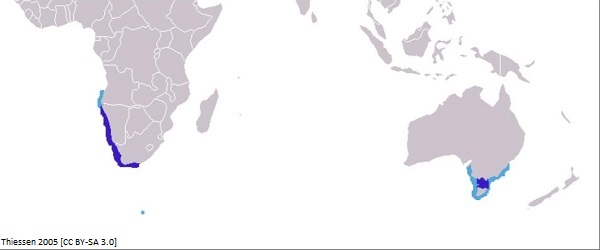
It doesn’t even need to end at just two different species. Give it enough time (probably another few hundred thousand years at least) and a third brown fur seal subspecies might emerge. And recent history has already given us an idea for how this process might start, if it hasn’t already, with a paper from 1983 reporting the discovery of a cape fur seal on Marion Island, a subantarctic spit of land that’s almost 1,200 miles southeast of Cape Town. The island’s beaches were no strangers to fur seals with both the Antarctic and Subantarctic fur seal already in residence, but this was still very far from the warm waters where cape fur seals usually roam. But if this one individual found its way there, then it’s possible (however improbable) that others will follow and leave their native shores behind.

It would be nice if nature stayed still and straightforward enough for us to work out what goes where and who does what. The job of most naturalists would probably be less stressful if this was the case. But on the other hand, life in the ocean (and beyond) only got to where it is today through change. The planet itself has gone through a plethora of extreme changes during its history, each time giving the lifeforms of that particular time period two choices, evolve or die. That said, the one thing that we, and every other species around today, could do without is climate change speeding up the process to the point where it all becomes an uncontrollable mess.
From a human perspective
Both ‘true’ seals and fur seals have endured plenty of interference to their everyday lives as a consequence of human activity (pollution, habitat destruction, climate change etc). Worse still, they have been directly and violently hunted in the past, with many countries having a history of exploiting them for their meat and to remove them as competitors for other natural resources. For example, grey seals around the UK were culled between 1977 and 1982 in an effort to keep them from consuming commercial fish species such as salmon. Putting aside the ethical arguments for a moment, substantial though they are, these culls never seemed to actually benefit the fisheries they were supposedly protecting. Nevertheless, there are probably still people out there who believe that the only good seal is a dead seal.
In the case of the cape fur seal, hunting has persisted well into the present day, especially in Namibia where both adults and pups are hunted annually between August and November. In South Africa, the practice was suspended in 1990, though some limited culls have been carried out since. Fortunately, the whole species (combining the populations of cape fur seals and australian fur seals) is still classified as ‘Least Concern’ by the IUCN Red List. This assessment was last updated in 2015 and a lot can happen in nine years, but the overall picture still appears promising, though this could be swayed by public perception (among other factors).
Even when our intentions are benign, cape fur seals won’t always respond well to a human’s presence in what should be their natural habitat. Just last year (2023) papers reported on a series of attacks on bathers around Cape Town. The fact that an attack happened isn’t particulalry noteworthy since there’s bound to be the odd isolated incident, especially when entitled and/or ignorant fools are involved. But it was the sudden surge of the attacks that drew media attention, a surge that was soon attributed to a toxic algae concealed within the fish that the cape fur seals were eating. The resulting effects on their brain caused them to be unusually aggressive in the face of potential danger. Even the world of reality TV was affected with the aggressive fur seals disrupting the production of that year’s season of Love Island (so it’s not all bad news).
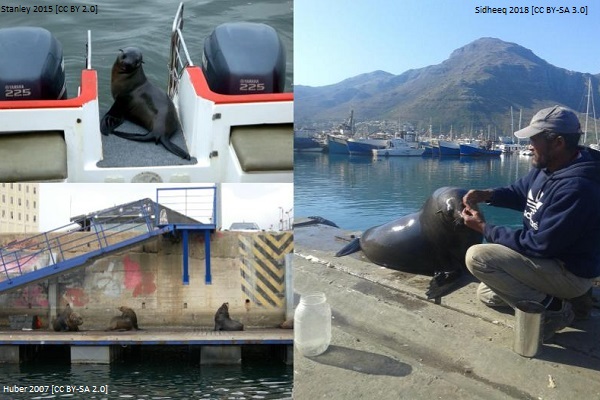
In all seriousness, after everything that humanity has, and continues to put them through, you’d think that cape fur seals would only see us as the enemy, something to be avoided if possible, or fought off if necessary. But back in 1969, a very different relationship was presented on our TV screens through an episode of ‘The Undersea World of Jacques Cousteau’.
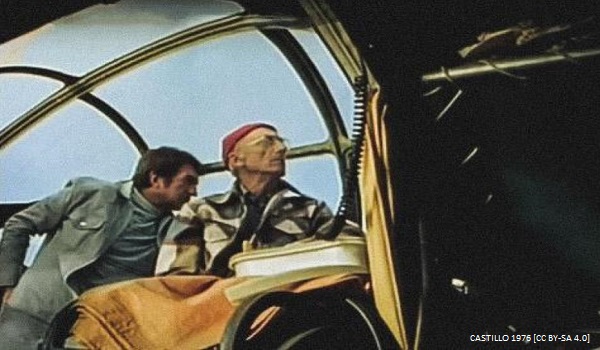
Having also founded the Cousteau Society in 1973 and launched a worldwide, and successful, petition to protect Antarctica from mineral exploitation in 1990, his conservation credentials are also in good order (probably the biggest understatement I’ve ever written in an article).
‘The Unexpected Voyage of Pepito and Cristobal’ focussed almost entirely on an experiment to determine if the titular cape fur seals could form an affectionate bond with the crew of the Calypso (Cousteau’s research vessel), similar to that between a dog and their owner. To achieve this end, the Calypso team ‘acquired’ Pepito and Cristobal as two young fur seals (not pups) from a colony on the appropriately named ‘Seal Island’ in False Bay, near the southwestern edge of South Africa. During the Calypso’s subsequent crossing of the Atlantic Ocean, food was used to train the fur seals into trusting and interacting with their new human companions. This was first done on board the ship in a purpose built training pen and then in the ocean with two of Calypso’s divers.
For its time, the episode, and the series as a whole, would have been ground breaking. One particular review on the episode’s IMDb page argues that it’s “The sort of nature documentary you’d never see today!”, but this was an argument against taking Pepito and Cristobal away in the first place and then habituating them to the extent that, if anything, they became too friendly with people. This was particularly evident with Cristobal who wandered away from the Calypso whilst they were in Caribbean water, and then acquainted himself with a fisherman in Puerto Rico. After eating a large portion of the fisherman’s catch, he was sold to a family, who then agreed to return Cristobal to the Calypso team once the story reached them. All things considered, he was lucky to be treated with such kindness and reunited with Pepito. His fate could have been a lot worse.
Skimming over the scientific value of the Pepito and Cristobal experiment (which feels like a debate for another day), the ethical concerns raised by the IMDb review do, in my opinion, have merit. Disturbing an animal’s natural behaviour, even to a relatively minor extent, can cause them avoidable stress, injury and, if repeated enough times, changes to their behaviour that can put them at risk from other dangers (natural or otherwise). This was even mentioned in my last article on whale sharks. But this is all based on what we know now, meaning we can probably explain the whole affair as a product of late 1960s thinking. So long as we don’t forget why perspectives have changed over time.
Jacques Cousteau himself was a testament to this with one of his earliest forays into underwater filmmaking with the 1956 documentary ‘The Silent World’. It was widely celebrated at the time, winning five awards, including the Oscar for best documentary and the Palme d’Or award at the Cannes Film Festival. But there are some segments of the film that have not aged well, particularly (but limited to) the crew of the Calypso slaughtering multiple sharks for nothing more than scavenging on an already dead whale, which had been mortally wounded by the ship’s propellers.
“For us divers, sharks are mortal enemies.”
“A dead whale or a man in the sea, it is the same thing to sharks.”
Jacques Cousteau (1956)
But over a decade later, another episode of his undersea world series, simply titled ‘Sharks’, presented a far more nuanced appreciation for these large fish.
“The shark is said to be a fearsome brute, but this is not always true.”
“The shark is a splendid beast, one of the sea’s most magnificent creatures.”
Jacques Cousteau (1968)
Also, if you were to watch the 2021 documentary ‘Becoming Cousteau’, you would see footage from a television interview where he specifically reflects on the shark sequence from ‘The Silent World’. “I couldn’t agree. I cannot show it anymore… we couldn’t handle the shark the same way today.” Regretfully, I couldn’t find out what year that interview took place (though it was probably in the 1970s), but it is clear that his view of sharks had changed dramatically and for the better.
In the interest of being inescapably clear, I am not drawing attention to the unflattering parts of Cousteau’s legacy for the sake of it. Without claiming to be an expert on the man, it’s still an undeniable fact that he was a pioneer in exploring the underwater world and raising awareness of its beautiful mystery. His was a life of incredible achievements that came with more than a few mistakes along the way (the treatment of Pepito and Cristobal could be considered one of them). But he acknowledged many of these mistakes, not just with his words, but with his actions as he campaigned tirelessly to protect the underwater world (for more details I recommend visiting the Cousteau Society website). Better that, then keeping yourself stuck in the past, clinging to a way of thinking that only used to make sense.
Sources
National Oceanic and Atmospheric Administration. 2023. How much water is in the ocean?. https://oceanservice.noaa.gov/facts/oceanwater.html#:~:text=About%2097%20percent%20of%20Earth’s,in%20glaciers%20and%20ice%20caps. Last accessed 11/03/2024
Seal Conservation Society. South African and Australian Fur Seals (Arctocephalus pusillus). https://www.pinnipeds.org/seal-information/species-information-pages/sea-lions-and-fur-seals/south-african-fur-seal. Last accessed 28/01/2024
Wikipedia. 2024. Brown fur seal. https://en.wikipedia.org/wiki/Brown_fur_seal. Last accessed 28/01/2024
Gondwana Collection Namibia. CAPE FUR SEAL. https://namibian.org/nature/marine-life/seals/cape-fur-seals. Last accessed 28/01/2024
Strydom et al. 2022. Factors that influence Cape fur seal predation on Cape gannets at Lambert’s Bay, South Africa
Nuwer. 2015. Fur Seals Caught Preying on Sharks Off South Africa. https://www.smithsonianmag.com/science-nature/fur-seals-caught-preying-sharks-south-africa-180954779/. Last accessed 28/01/2024
Peterson. 2015. Gruesome Meal: Seagulls Snack on Baby Seals’ Eyeballs. https://www.livescience.com/51944-seagulls-eats-seal-eyeballs.html. Last accessed 28/01/2024
De Simone. 2023. South Africa’s shark spotters back in action as great whites return. https://www.bbc.co.uk/news/world-africa-67771596. Last accessed 11/03/2024
MARINEBIO. South African / Australian Fur Seals, Arctocephalus pusillus. https://www.marinebio.org/species/south-african-australian-fur-seals/arctocephalus-pusillus/. Last accessed 04/02/2024
Australian Museum. 2022. Australian Fur Seal. https://australian.museum/learn/animals/mammals/australian-fur-seal/. Last accessed 04/02/2024
Kirkman and Arnould. 2018. Cape and Australian fur seals: Arctocephalus pusillus pusillus and A. p. Doriferus
Malan et al. 2022. Palaeoclimatic changes resulted in range expansion and subsequent divergence in brown fur seals, Arctocephalus pusillus
Britannica. Subspecies. https://www.britannica.com/science/subspecies. Last accessed 04/02/2024
Whale and Dolphin Conservation. CLYMENE DOLPHIN. https://uk.whales.org/whales-dolphins/species-guide/clymene-dolphin/. Last accessed 04/02/2024
Kerley. 1983. Record for the Cape fur seal Arctocephalus pusillus pusillus from subantarctic Marion Island
Britannica. Marion Island. https://www.britannica.com/place/Marion-Island. Last accessed 20/03/2024
Balmelli and Wickens. 1994. Estimates of daily ration for the South African (Cape) fur seal
Arnould et al. 2003. Historical dynamics of the Australian fur seal population: evidence of regulation by man?
IUCN Red List. 2015. Afro-Australian Fur Seal. https://www.iucnredlist.org/species/2060/45224212. Last accessed 28/01/2024
Wilson. 2020. Seal-Fisheries Interactions: PROBLEMS, SCIENCE AND SOLUTIONS. https://bdmlr.org.uk/wp-content/uploads/2020/04/Resources-seal-fisheries-interactions.pdf. Last accessed 11/03/2024
France 24 English. 2023. What’s behind South Africa’s rise in seal attacks? • FRANCE 24 English. https://www.youtube.com/watch?v=46dvA3ZDR30. Last accessed 28/01/2024
NEWKEY-BURDEN. 2023. Brain-damaged seals attack bathers. https://theweek.com/news/world-news/959266/seals-driven-mad-by-acid-attack-bathers. Last accessed 28/01/2024
Rainbird. 2023. Love Island bosses warned over dates due to ‘dangerous’ seals attacking in South Africa. https://www.mirror.co.uk/tv/tv-news/love-island-bosses-warned-over-28992708. Last accessed 28/01/2024
The Undersea World of Jacques Cousteau: The unexpected voyage of Pepito and Cristobal. 1969. Produced by David L. Wolper Productions and Metromedia Productions
World Cat. The unexpected voyage of Pepito and Cristobal. https://search.worldcat.org/title/unexpected-voyage-of-pepito-and-cristobal/oclc/85975001. Last accessed 28/01/2024
IMDb. The Unexpected Voyage of Pepito and Cristobal. https://www.imdb.com/title/tt0868919/. Last accessed 28/03/2024
Cornwall Wildlife Trust. 2021. Marine and Coastal Wildlife Disturbance in Cornwall. https://www.cornwallwildlifetrust.org.uk/sites/default/files/2021-10/Marine%20Wildlife%20Disturbance%20in%20Cornwall%20Summary%20Report%202021%20final.pdf. Last accessed 05/04/2024
Police Service of Northern Ireland. MARINE WILDLIFE DISTURBANCE. https://www.psni.police.uk/sites/default/files/2022-09/Partnership%20for%20Action%20Against%20Wildlife%20Crime%20NI%20%28PAW%20NI%29%20-%20Marine%20Wildlife.pdf. Last accessed 05/04/2024
NOAA Fisheries. Viewing Marine Life. https://www.fisheries.noaa.gov/insight/viewing-marine-life. Last accessed 05/04/2024
The Silent World. 1956. [DVD]. Directed by Jacques-Yves Cousteau and Louis Malle. Produced by FSJYC Production; Requins Associés; Société Filmad; Titanus
IMDb. The Silent World. https://www.imdb.com/title/tt0049518/. Last accessed 28/03/2024
The Undersea World of Jacques Cousteau: Sharks. 1968. Directed by Philippe Cousteau and Jack Kaufman. Produced by David L. Wolper Productions, Les Réquins Associés, Metromedia Productions
Becoming Cousteau. 2021. Directed by Liz Garbus. Produced by Story Syndicate, ACE Content, National Geographic Documentary Films, National Geographic
The Cousteau Society. ABOUT THE COUSTEAU SOCIETY. https://www.cousteau.org/about-us/#cousteau. Last accessed 28/03/2024
Image sources
Avitopia www.avitopia.net. 2017. [CC BY-SA 3.0 (https://creativecommons.org/licenses/by-sa/3.0)]. https://commons.wikimedia.org/wiki/File:Cape_Gannet_-_Morus_capensis.JPG
Diego Delso. 2020. [CC BY-SA 4.0 (https://creativecommons.org/licenses/by-sa/4.0)]. https://commons.wikimedia.org/wiki/File:Tibur%C3%B3n_azul_(Prionace_glauca),_canal_Fayal-Pico,_islas_Azores,_Portugal,_2020-07-27,_DD_21.jpg
Robur.q. 2015. [CC BY-SA 4.0 (https://creativecommons.org/licenses/by-sa/4.0)]. https://commons.wikimedia.org/wiki/File:Arctocephalus_pusillus_5_-_Cape_fur_seal.JPG
Bernard DUPONT from FRANCE. 2018. [CC BY-SA 2.0 (https://creativecommons.org/licenses/by-sa/2.0)]. https://commons.wikimedia.org/wiki/File:Cape_Fur_Seals_(Arctocephalus_pusillus)_male_quarrelling_with_a_female_…_(32628709318).jpg
Hans Hillewaert. 2007. [CC BY-SA 3.0 (https://creativecommons.org/licenses/by-sa/3.0)]. https://commons.wikimedia.org/wiki/File:Arctocephalus_pusillus_(Cape_fur_seal_pup).jpg
Charles J. Sharp. 2023. [CC BY-SA 4.0 (https://creativecommons.org/licenses/by-sa/4.0)]. https://commons.wikimedia.org/wiki/File:Australian_fur_seal_(Arctocephalus_pusillus_doriferus)_female_Bruny.jpg
Mirko Thiessen. 2005. [CC BY-SA 3.0 (http://creativecommons.org/licenses/by-sa/3.0/)]. https://commons.wikimedia.org/wiki/File:Arctocephalus_pusillus_distribution.png
Paul venter. 2011. [CC BY-SA 3.0 (https://creativecommons.org/licenses/by-sa/3.0)]. https://commons.wikimedia.org/wiki/File:Arctocephalus_pusillus01.jpg
David Stanley from Nanaimo, Canada. 2015. [CC BY 2.0 (https://creativecommons.org/licenses/by/2.0)]. https://commons.wikimedia.org/wiki/File:Atlantic_Cape_Fur_Seal_(19313884576).jpg
Sidheeq. 2018. [CC BY-SA 3.0 (https://creativecommons.org/licenses/by-sa/3.0)]. https://commons.wikimedia.org/wiki/File:Man_feeding_to_seal,_Cape_Town_harbour_.jpg
Joachim Huber. 2007. [CC BY-SA 2.0 (https://creativecommons.org/licenses/by-sa/2.0)]. https://commons.wikimedia.org/wiki/File:Seals_in_port_of_Cape_Town_(3236534613).jpg
ENRIQUE MARTINEZ CASTILLO. 1976. [CC BY-SA 4.0 (https://creativecommons.org/licenses/by-sa/4.0)]. https://commons.wikimedia.org/wiki/File:Jaques_Yvez_Cousteau_Ramon_Bravo_PBY_catalina_calypsoII_1976.jpg
All other images are public domain and do not require attribution.
For more bitesize content and ocean stories why not follow ‘Our world under the waves’ on…
 Our world under the waves

,_canal_Fayal-Pico,_islas_Azores,_Portugal,_2020-07-27,_DD_21.jpg)

_male_quarrelling_with_a_female_..._(32628709318).jpg)
.jpg)
_female_Bruny.jpg)


.jpg)

.jpg)
