by Matthew Norton
“If in doubt, gross them out!”
It’s a phrase I’ve said many times at my aquarium day job, usually while explaining my techniques for engaging with members of the public. And I stand by it to this day, because there are many creatures of the sea (and beyond) who resort to rather disgusting tricks in order to survive. Tricks that translate into powerful tools for capturing the attention, and imagination, of almost any visitor, particularly those of a younger age, particularly when the conversation drifts towards the humble-looking sea cucumber.
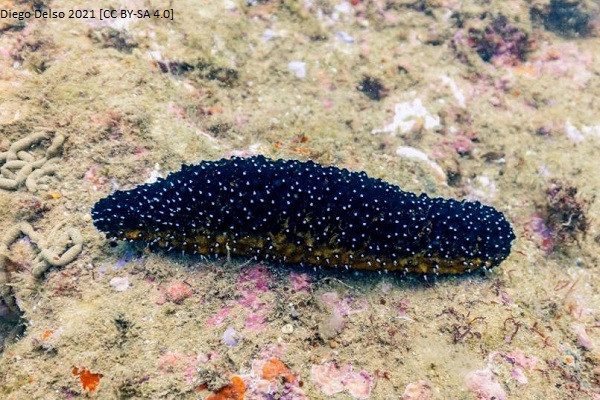
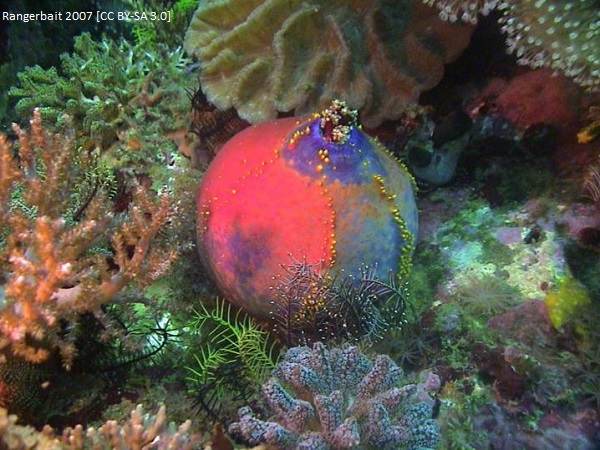
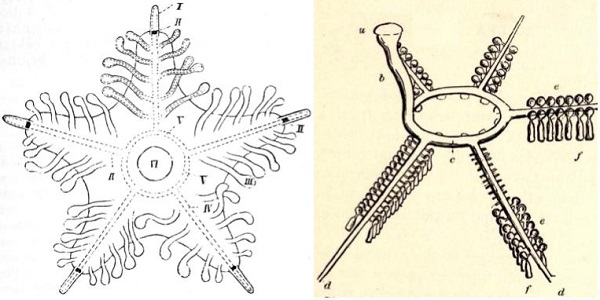
Despite the name and appearance of the standard sea cucumber (if there was ever such a thing), they are not vegetables. They actually belong to a class of marine invertebrate animals called “Holothurians”, which themselves belong to the Echinoderm phylum, making sea cucumbers the cousins of starfish, brittle stars and sea urchins. And just like their closest relatives, sea cucumbers have a five-way symmetry about them, it’s just not as obvious, given how it’s almost completely masked by the bilateral (two-way) symmetry you see at first glance. But look inside and you’ll find that the body is stretched out from five different points along its length. In some species, you can sort of see it from the five distinct grooves, nerve chords and channels laden with tube feet (or some other sensory structure) running between the head and anus. With regards to the latter, the tube feet that would otherwise be sticking out of their back may be modified, greatly reduced in size, or not be there at all. But the foundations may still be present.
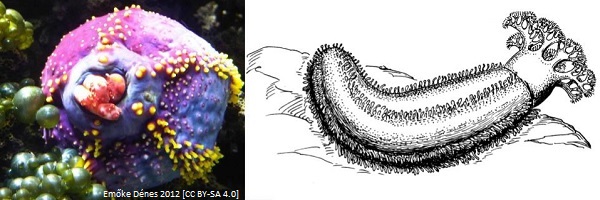
Fundamental though the body symmetry is for making the connection between starfish and sea cucumbers, there are far easier similarities to draw upon. For example, the aforementioned tube feet are much like those you would find tucked underneath the arms of a starfish, almost as if a sea cucumber was the arm of a starfish who has detached from the main animal and just wandered off. This is definitely not how sea cucumbers are born, but they use their tube feet for moving, sticking to surfaces and sensing their environment, just like a starfish (see Starfish article for more details).
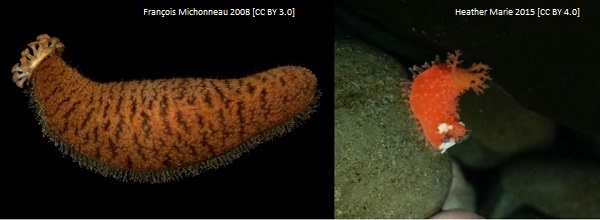
Curiously, the mechanism used to operate each tube foot is inherently tied to a hydraulic based system that runs through five ambulacral canals along the length of the sea cucumber. Also known as the “water vascular system”, it’s another fundamental feature among the echinoderms, but while starfish draw in actual seawater to maintain this system, sea cucumbers use a special body fluid instead, keeping their channels and internal organs isolated from the surrounding ocean. But the principle is much the same either way, with each foot being filled with water/fluid through a valve, which can then be closed to prevent any water/fluid escaping back into the canal. Under these conditions the relevant muscles can then be contracted, squeezing the foot and causing it to extend outwards, since there’s nowhere else for the pressurised water/fluid to go. And when the tip of the foot makes contact with a surface, the pressure is relieved, but only at the centre of the foot’s tip, not around the edges. This produces the necessary suction against that surface, sort of like the rubber suction cups used by a cat burglar or secret agent to climb skyscrapers. In the case of a starfish/sea cucumber, the initial suction can then be supplemented with a naturally produced adhesive.
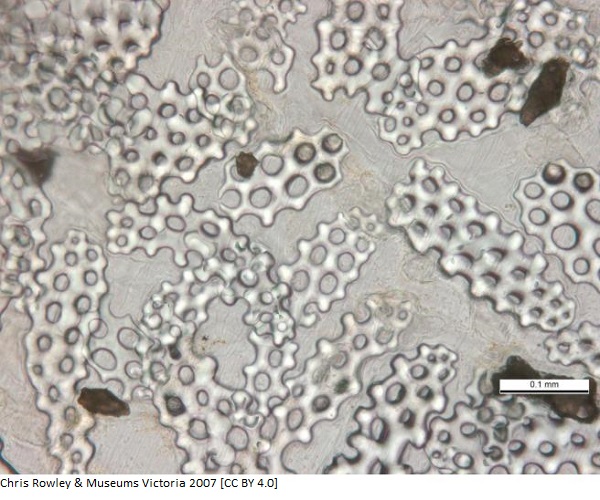
Sea cucumbers also share the starfish’s knack for growing back lost body parts. An undoubtedly useful skill during those desperate times when they must eject their own guts in order to trick or entangle their predators. These ‘guts’ are called “cuvierian tubules” and typically look like thin strings of spaghetti or, as is the case in the cotton spinner sea cucumber, white sticky threads. Many species go even further, deploying threads that are laced with toxins that will really deter any animal looking to do them harm. Such harmful chemicals include saponins, a group of toxins also found in some plants, which, when used in high concentrations, can dissolve cell membranes, especially those of red blood cells. Should the cuverian tubules of such a desperate sea cucumber slip into the delicate gills of a fish, they could do great damage indeed. Especially if the fish lacks the antidote chemicals produced by the sea cucumber so they don’t accidentally poison themselves. The beginning of Indiana Jones and the Temple of Doom suddenly springs to mind.
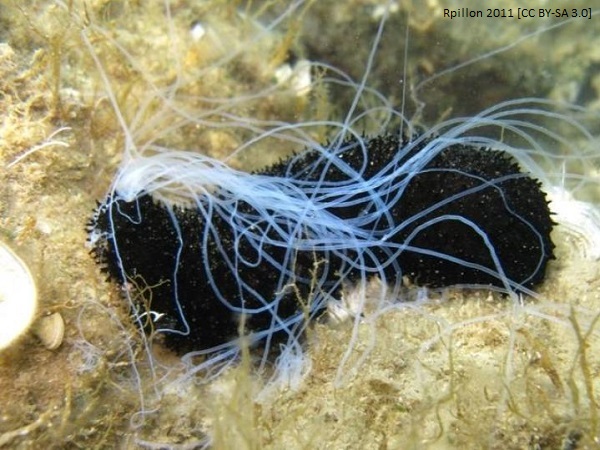
“… the most wonderful part of this tale is, that the catastrophe, so grievous to the spectator who witnesses such a tragedy, seems to be of very small importance to the actor, as the creatures seem to get on just as well without any bowels as when possessed as such trifling additions to their economy; and, what is more, can reproduce them in a most convenient manner…”
But without eyes, how can they know when they’re under attack? They certainly can’t see the danger coming if they have no visual information to work from, nor can they find their own food this way. Fortunately, they have sensory ‘papillae’ on their back, which appear as bumps, warts, or even short tentacles in some species, whilst being almost completely unnoticeable in others. In any case, these papillae can provide their sea cucumbers with information from touch and dissolved chemicals which, in the right circumstances, could give them the jolt to act before they are eaten.
This doesn’t mean that sea cucumbers will go straight to the nuclear option of ejecting their cuverian tubules, sometimes they’ll respond to a threat by quickly stiffening or unstiffening their bodies. Both forms have their potential uses, with a stiffened sea cucumber being more difficult to break into, while a squidgy sea cucumber may be able to move faster (relatively speaking) or squeeze itself into a hole where its attacker won’t (hopefully) be able to follow. It’s a feat they achieve with a body tissue layer made out of collagen, a structural protein that helps us humans to build our skin, bones, ligaments and so on. But sea cucumbers have adapted this protein into a layer of “catch connective tissue” (also known as “mutable collagenous tissue”), which can change its mechanical properties within minutes (sometimes within seconds) of getting the appropriate signal from the nervous system. Specifically, it’s the proteins acting as scaffolds between the collagen fibres which facilitate whatever change is required.
Naturally, sea cucumbers need to feed themselves as well as avoid being eaten. In many cases (though it’s always wise to assume there will be exceptions) they either sift out tiny pieces of food from the seafloor, or they filter out tiny particles from the water above. In both cases, they use the small podia (i.e. tentacles) surrounding their mouth to trap these pieces of food, before being wiped clean by the oesophagus (like licking yoghurt from a spoon), after which they return to active food-gathering duty. All while sensing and picking out the edible pieces from the sediment (where applicable) through the detection of chemical stimuli (i.e. taste). Ironically, the smallest known species of sea cucumber, Psammothuria ganapati, lives between grains of sand and may end up being foraged by their larger kin.
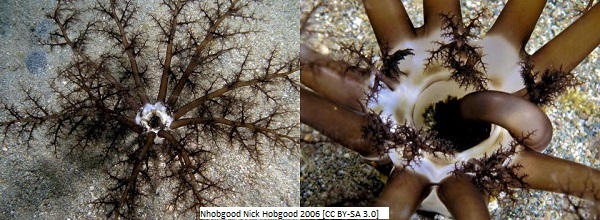
But it’s worth mentioning that the size, number and shape of feeding podia represents a wide realm of diversity among the 1,700+ species of sea cucumber, depending on how and what they feed on.
Unlike their starfish cousins, sea cucumbers are fortunate enough to have their mouth and anus at opposite ends of their body, meaning they don’t have to eat through their backside, or poo through their mouth. Alas, it appears their luck ran out when it came to their breathing apparatus, with most species possessing branched structures called “respiratory trees”, which get their supply of seawater, from which the oxygen is extracted, through their backside. As gross as it sounds, it’s a genuinely useful adaptation if one happens to be mouth deep, searching for food in that particular sea cucumber’s sediment of choice. And should that search prove fruitless, the anus can serve as a secondary mouth for catching small particles and absorbing nutrients directly from the water. A state of being that is professionally described as being “nutritionally bipolar”.
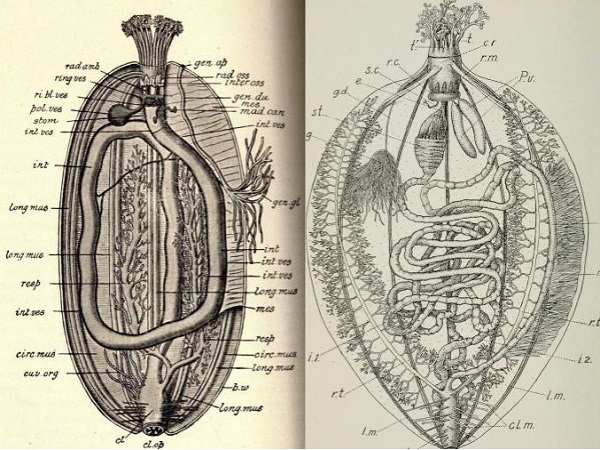
These would be absent from some diagrams because some groups of sea cucumber, such as the deep sea Apodida group, lack respiratory trees (and tube feet) and breathe directly through their skin instead. Sounds strange, but in theory any surface can be adapted into a gas exchange surface.
But this arrangement becomes noticeably less ideal when a tiny pearlfish enters the scene. And when I say “enter”, I mean up the sea cucumber’s backside in an effort to hide from predators. Not only would this be uncomfortable, and undignified, but in extreme cases the pearlfish may be blocking the sea cucumber’s ‘airway’, or feeding directly on their internal organs, including those used for reproduction. You would think that the previously mentioned toxins deployed with the sea cucumber’s cuverian tubules would deter such a direct invasion, but pearlfish are a slippery sort, literally coating themselves in a thick layer of mucus that keep the toxins from hitting the actual fish. Some species thus resort to more extreme tactics, such as the blue sea cucumber (Actinopyga caerulea) who actually grow teeth in their rear end to deter unwanted house guests. But in other cases, the sea cucumber appears to have little choice in the matter and must tolerate the pearlfish’s presence as best it can. I wish I could say that’s where the similarities end between starfish and sea cucumbers, but the appropriately named star pearlfish (Carapus mourlani) has been found living within the bodies of both.
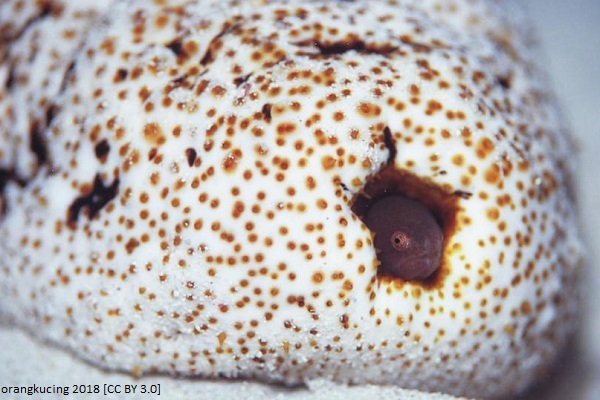
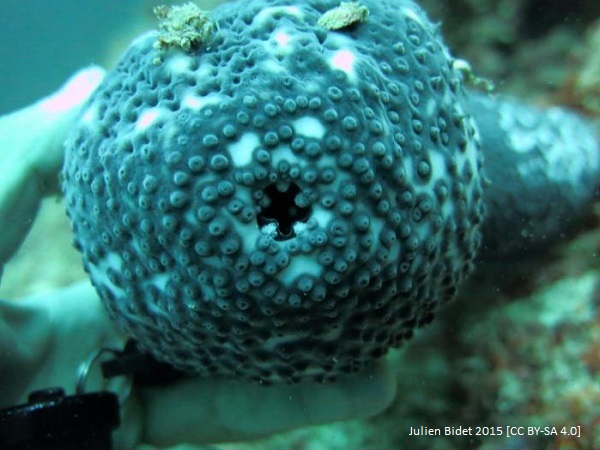
Curiously, there are also accounts of pearlfish wriggling into the confines of an oyster shell and then finding itself entombed within the nacre (an inner shell layer) of the oyster. The National History Museum has one such shell with the remains of a pearlfish within.
As gross as they are, sea cucumbers remain a highly successful group of sea creatures, not only because of the sheer number of species out there (that we know of), but also in their ability to establish themselves in seemingly every marine habitat out there, from the seashore to the deep sea.
From a human perspective
Sea cucumbers may not taste anything like regular cucumbers, but they are a delicacy in some parts of the world with Asian cuisines being particularly inclined towards catching and consuming them, as they have done for centuries. Such traditional harvests were once carried out by female free divers called ama in Japan and haenyeo in Korea, while in parts of China they would use the oil extracted from hunted seals to create a surface slick for illuminating the sea floor below and making it easier to pinpoint the sea cucumbers. These kinds of methods are still reflected, to some extent, by the artisanal sea cucumber fisheries operating today, while others opt for semi-industrial methods such as collecting them by hand with the aid of snorkels and scuba gear, or trawlers taking them as bycatch. The lower-tech solutions are arguably better, not just for conservation and cultural reasons, but simply because they incur lower costs while still reaping considerable rewards. Especially in communities with a long history of sea cucumber fishing.
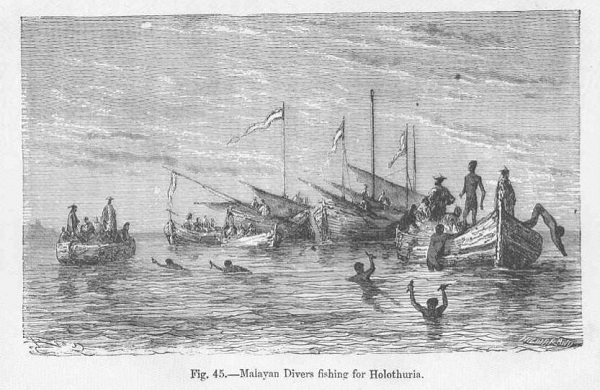
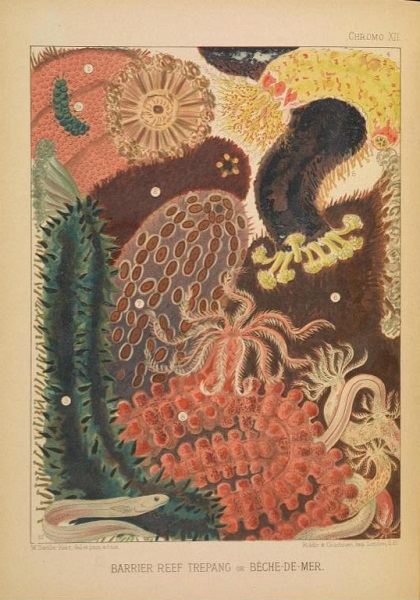
It was even referenced in Jules Verne’s 20,000 Leagues Under The Sea (which was published around the same time as the date of this illustration), where Captain Nemo offers Professor Aronnax “preserves of sea cucumber that a Malaysian would declare to be unrivalled in the entire world” among other foods at a banquet aboard the Nautilus.
However, once a sea cucumber is taken from the ocean, they begin to deteriorate very quickly, making it imperative to process and preserve the meat as quickly as possible. This often involves cleaning them out with seawater and then drying them out at some stage, but different cultures have employed different variations of the technique throughout recorded history. In China, during the Quinn Dynasty (1796-1820), the sea cucumbers would be boiled, dried under the sun, marinated in salt, washed to remove as much of the salty taste as possible and then covered in coal ash to turn the meat hard and black. In Japan, especially on Rishira Island, they would be boiled in a large iron pot, filled with seawater, sage brush and scrap iron, then gutted and dried out. In Indonesia, since the 18th century (if not before), they were typically boiled with mangrove bark to both preserve the sea cucumber and dye them red. And in the Philippines, they tend to be buried in the sand overnight, washed in hot water and then dried out. Whatever the case, so long as a sea cucumber is well preserved, it can then be fried, roasted, simmered, braised, grilled, stewed, or cooked by some other method, ready for human consumption.
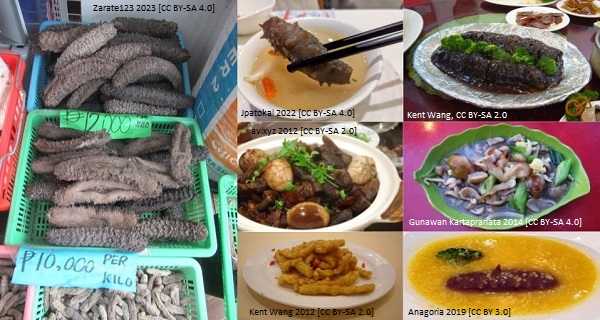
Curiously, the economic value of each sea cucumber is not just determined by its size, but also the number of papillae. This has prompted research into selective breeding and optimising the environments of sea cucumbers farms in order to meet this aesthetic demand. Strangely, a 2025 study on Japanese sea cucumbers found that blue light was ideal for papillae growth.
Beyond Asia, sea cucumbers have been cleaned with papaya leaves in Madagascar and smoked by Inuits and other native communities in the Canadian Arctic. Meanwhile, the royal sea cucumber (Parastichopus regalis) has been consumed by fishermen in Eastern Spain, specifically Catalonia, Valencia and the Balearic Islands, for at least a century, albeit under local names such as “espardenya”, “llongo”, “llonguet” and “sola”.
Diners from other cultures may struggle to comprehend the widespread appeal of sea cucumbers, given their outward appearance. But they are very nutritious, being low in fat and rich in omega-3, omega-6, protein and a number of minerals and vitamins. Eating sea cucumbers, particularly those dried and processed with salt and collagen, might even help to treat type 2 diabetes by tackling the formation of advanced glycation end products (or AGEs for short) from the mixing of sugars (of which there is an excess). It’s these AGEs that cause the especially damaging complications of the condition, such as heart disease, kidney disease, cancer and so on. Not a bad range of benefits from these unassuming invertebrates.
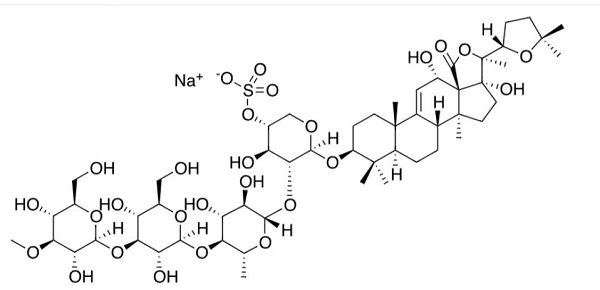
Beyond the dinner plate, sea cucumbers habe also earned yet interest for their medical applications. Given their use in traditional Chinese medicine for treating everything from cuts and open wounds to dermatitis, arthritis and even dysfunction in the bedroom, they certainly warranted some scientific investigation. And what a treasure trove we found as a result, so many medicines based on the chemicals they naturally produce, so much variety in their uses. These include drugs for treating cancer, hypertension, inflamation, bacterial and fungal infections as well as anti-coagulants and anti-angiogenic compounds among others. For some of these compounds, their medical application and their purpose for the sea cucumber that produces them may be one and the same. For example, there is evidence to suggest that saponin toxins, already used by sea cucumbers to repel larger predators, can repel microscopic invaders as well. Everyone needs an immune system of some variety.
But let us not forget the vital ecosystem services that sea cucumbers provide, from recycling nutrients in the sediment and removing excess waste from aquaculture setups to mixing and airing out the sediment in which they live and burrow through (a process known as bioturbation). Such activities can benefit important habitats like seagrass beds, which in turn provide safe havens for not only delightful seahorses, but also the young of fish species which support many commercial fisheries. Something that’s worth considering with regards to the massive demand for sea cucumbers, especially in Asian seafood markets, many of which are shipped in from outside the region, putting a heavy strain on sea cucumber stocks all over the world. One quick example can be found around the Galapogos islands, where sea cucumbers were heavily fished from 1988 until regulations were implemented in 2001 to prevent overexploitation.
As it stands, around 58% of the world’s sea cucumber fisheries are considered to be overexploited or depleted, though these figures may be even higher in certain regions. Discrepancies can also be found between species, with only around 60 species (out of the 1,700+ species we know of) being of commercial importance and thus bearing the brunt of the fishing pressure. At the same, their tendency to feed on the small morsels buried in the sand, or floating in the water, makes it almost inevitable for them to pick up contaminants that we have introduced to their environment, such as microplastics and heavy metals. I’m not saying people shouldn’t eat sea cucumbers, we just need to be careful about how many we take, when and where we source them, and the kind of environment we provide for such bountiful harvests.
Last, but not least, let us not forget about the value of sea cucumbers as simple natural wonders. There’s no doubt (not from anyone sensible) that data, scientific breakthroughs and putting food on the table is important, but facts alone can only go so far in asserting something’s value to us, and the need to protect it for future generations. You also need the stories, and the creativity behind them.
Nature has done some of the work for us already, with its mechanisms of evolution producing a whole variety of different sea cucumber species. And being the creative species we are, there is plenty of scope for all the artists out there to take those stories further. And by artists, I mean those who actually do the creating themselves, rather than using AI. The inspiration is out there for all of us to use, be it drawing sea cucumbers, sculpting them, animating them, writing about or recording a brief rambling monologue about them. Whatever medium you employ, whatever angle you take, the sea cucumber of your mind will be uniquely yours.
Sources
Chetan-Welsh. Sea cucumbers: Weird and wacky natural recyclers. https://www.nhm.ac.uk/discover/what-is-a-sea-cucumber.html. Last accessed 07/01/2026
MarLIN. 2007. Cotton spinner (Holothuria forskali). https://www.marlin.ac.uk/species/detail/1491. Last accessed 07/01/2026
Smirnov. 2014. Sea cucumbers symmetry (Echinodermata: Holothuroidea)
The Ethogram. 2021. Creature Feature: Sea Cucumbers. https://theethogram.com/2021/01/05/creature-feature-sea-cucumbers/. Last accessed 07/02/2026
Mashanov et al. 2009. The central nervous system of sea cucumbers (Echinodermata: Holothuroidea) shows positive immunostaining for a chordate glial secretion
Exploring Our Fluid Earth. Phylum Echinodermata. https://manoa.hawaii.edu/exploringourfluidearth/biological/invertebrates/phylum-echinodermata. Last accessed 07/02/2026
Oceanic Research Group. Echinoderms: Spiny-Skinned Creatures. https://oceanicresearch.org/wonders-of-the-sea/echinoderms/. Last accessed 07/02/2026
Mohsen and Yang. 2021. Sea cucumbers: Aquaculture, biology and ecology
Li et al. 2013. Comparison of cells free in coelomic and water-vascular system of sea cucumber, Apostichopus japonicus
Wang et al. 2025. The migration of cells from the water-vascular system to the coelom provides evidence supporting the origin of coelomocytes in sea cucumber Apostichopus japonicus
Pinsino et al. 2007. Coelomocytes and post-traumatic response in the common sea star Asterias rubens
Castillo. 2006. Predator defense mechanisms in shallow water sea cucumbers (Holothuroidea)
Eeckhaut et al. 2015. Effects of holothuroid ichtyotoxic saponins on the gills of free-living fishes and symbiotic pearlfishes
Nguyen et al. 2020. An overview of saponins-a bioactive group.
Thimmappa et al. 2022. Biosynthesis of saponin defensive compounds in sea cucumbers
Kearly. 1862. Links in the chain; or, Popular chapters on the curiosities of animal life, by George Kearley with illustrations by F.W. Keyl. J. Hogg and Sons. London. https://archive.org/details/linksinchainorpo00keariala/page/124/mode/1up. Last accessed 17/01/2026
Motokawa. 1985. Catch connective tissue: the connective tissue with adjustable mechanical properties
Yamada et al. 2010. A novel stiffening factor inducing the stiffest state of holothurian catch connective tissue
Mo et al. 2016. Interfibrillar stiffening of echinoderm mutable collagenous tissue demonstrated at the nanoscale
Liu et al. 2025. Papillae growth and molecular responses in sea cucumber (Apostichopus japonicus) exposed to light spectra
Fankbonker. 1978. Suspension-feeding mechanisms of the armoured sea cucumber Psolus chitinoides Clark
Mai et al. 2025. Expression regulation network in papillae of sea cucumbers: Whole-transcriptome and DNA methylation datasets
VandenSpiegel et al. 1995. Fine structure of the dorsal papillae in the holothurioid Holothuria forskali (Echinodermata)
Bouland et al. 1982. The fine structure of the buccal tentacles of Holothuria forskali (Echinodermata, Holothuroidea)
Sutterlin and Waddy. 1976. Tentacle movement patterns involved in feeding behaviour of the sea cucumber, cucumaria frondosa
Jaeckle and Strathmann. 2013. The anus as a second mouth: anal suspension feeding by an oral deposit‐feeding sea cucumber
Monterey Bay Aquarium. Warty sea cucumber. https://www.montereybayaquarium.org/animals/animals-a-to-z/warty-sea-cucumber. Last accessed 07/01/2026
Whelpley et al. 2025. Phylogenomic analyses of all major sea cucumber lineages provide a robust backbone of Holothuroidea
Oysterloff. The fish that’s also a pearl. https://www.nhm.ac.uk/discover/the-fish-thats-also-a-pearl.html. Last accessed 13/02/2026
Funnell. 2025. Meet The Pearlfish That Calls Sea Cucumbers’ Butts Home And Can Reverse Park Into Tight Spaces. https://www.iflscience.com/meet-the-pearlfish-that-calls-sea-cucumbers-butts-home-and-can-reverse-park-into-tight-spaces-79634. Last accessed 13/02/2026
Smithsonian Natural Museum of Natural History. 2012. Pearlfish from a Sea Cucumber. https://ocean.si.edu/ocean-life/fish/pearlfish-sea-cucumber. Last accessed 13/02/2026
FishBase. Carapus mourlani (Petit, 1934) Star pearlfish. https://www.fishbase.se/summary/Carapus-mourlani.html. Last accessed 13/02/2026
Pérez-Lloréns and Mouritsen. 2024. Sea cucumber: A scavenger overexploited, traded and turned into food (even a gastronomic delicacy)
Ramón et al. 2010. Royal cucumber (Stichopus regalis) in the northwestern Mediterranean: distribution pattern and fishery
Chang et al. 2011. Characteristics of papillae in wild, cultivated and hybrid sea cucumbers (Apostichopus japonicus)
Spencer. 2023. Scientists discover value-added benefits of sea cucumbers. https://www.ifis.org/blog/scientists-discover-value-added-benefits-of-sea-cucumbers. Last accessed 17/01/2026
Fagbohun et al. 2023. Saponins of North Atlantic sea cucumber: chemistry, health benefits, and future prospectives
Purcell et al. 2016. Ecological roles of exploited sea cucumbers
Slater. 2024. Role of sea cucumbers as an ecosystem service in land-based aquaculture
Darwin Initiative. 2025. Enhanced livelihoods with sea cucumbers. https://www.darwininitiative.org.uk/news/2025/05/10/enhanced-livelihoods-with-sea-cucumbers/. Last accessed 11/03/2026
Watkins et al. 2023. Effects of sea cucumber fishing on tropical seagrass productivity
Arnull et al. 2021. Ecological co-benefits from sea cucumber farming: Holothuria scabra increases growth rate of seagrass
Image sources
Diego Delso. 2021. [CC BY-SA 4.0 (https://creativecommons.org/licenses/by-sa/4.0)]. https://commons.wikimedia.org/wiki/File:Pepino_de_mar_negro_(Holothuria_forskali),_Parque_natural_de_la_Arr%C3%A1bida,_Portugal,_2021-09-10,_DD_59.jpg
Rangerbait at the English Wikipedia. 2007. [CC BY-SA 3.0 (http://creativecommons.org/licenses/by-sa/3.0/)]. https://commons.wikimedia.org/wiki/File:Sea_Apple_at_Cannibal_Rock_Indonesia_2002.jpg
Emőke Dénes. 2012. [CC BY-SA 4.0 (https://creativecommons.org/licenses/by-sa/4.0)]. https://commons.wikimedia.org/wiki/File:Pseudocolochirus_axiologus_-_Kew_1.jpg
François Michonneau. 2008. [CC BY 3.0 (https://creativecommons.org/licenses/by/3.0)]. https://commons.wikimedia.org/wiki/File:Actinopyga_echinites1.jpg
Heather Marie. 2015. [CC BY 4.0 (https://creativecommons.org/licenses/by/4.0)]. https://commons.wikimedia.org/wiki/File:Scarlet_Dwarf_Sea_Cucumber_(Lissothuria_nutriens).jpg
Chris Rowley and Museums Victoria. 2007. [CC BY 4.0 (https://creativecommons.org/licenses/by/4.0)]. https://commons.wikimedia.org/wiki/File:Apsolidium_falconerae_(F_109375)_ossicles.jpg
Rpillon. 2011. [CC BY-SA 3.0 (https://creativecommons.org/licenses/by-sa/3.0)]. https://commons.wikimedia.org/wiki/File:Holothuria_forskali_Rab2011_h_3798.JPG
Nhobgood Nick Hobgood. 2006. [CC BY-SA 3.0 (https://creativecommons.org/licenses/by-sa/3.0)]. https://commons.wikimedia.org/wiki/File:Neothyonidium_magnum_(Burrowing_sea_cucumber)_at_night.jpg
Nhobgood Nick Hobgood. 2006. [CC BY-SA 3.0 (https://creativecommons.org/licenses/by-sa/3.0)]. https://commons.wikimedia.org/wiki/File:Neothyonidium_magnum_(Burrowing_sea_cucumber).jpg
Orangkucing. 2018. [CC BY 3.0 (https://creativecommons.org/licenses/by/3.0)]. https://commons.wikimedia.org/wiki/File:EncheliophBoraborensorangkucing.jpg
Julien Bidet. 2015. [CC BY-SA 4.0 (https://creativecommons.org/licenses/by-sa/4.0)]. https://commons.wikimedia.org/wiki/File:Actinopyga_caerulea_dents_anales.JPG
Zarate123. 2023. [CC BY-SA 4.0 (https://creativecommons.org/licenses/by-sa/4.0)]. https://commons.wikimedia.org/wiki/File:Sea_cucumbers_in_Chinese_medicine_04.jpg
Jpatokal. 2022. [CC BY-SA 4.0 (https://creativecommons.org/licenses/by-sa/4.0)]. https://commons.wikimedia.org/wiki/File:Prickly_sea_cucumber_soup.jpg
avlxyz. 2012. [CC BY-SA 2.0 (https://creativecommons.org/licenses/by-sa/2.0)]. https://commons.wikimedia.org/wiki/File:Sea_cucumber_dish.jpg
Kent Wang. 2012. [CC BY-SA 2.0 (https://creativecommons.org/licenses/by-sa/2.0)]. https://commons.wikimedia.org/wiki/File:Sea_cucumber_dish_3.jpg
Kent Wang. 2012. [CC BY-SA 2.0 (https://creativecommons.org/licenses/by-sa/2.0)]. https://commons.wikimedia.org/wiki/File:Sea_cucumber_dish_2.jpg
Anagoria. 2019. [CC BY 3.0 (https://creativecommons.org/licenses/by/3.0)]. https://commons.wikimedia.org/wiki/File:20190905_185512_Sea_Cucumber_Dish_in_a_Restaurant_in_Zhumadian,_Henan,_China_anagoria.jpg
Gunawan Kartapranata. 2014. [CC BY-SA 4.0 (https://creativecommons.org/licenses/by-sa/4.0)]. https://commons.wikimedia.org/wiki/File:Haisom_Cah_Jamur_2.JPG
All other images are public domain and do not require attribution.
 Our world under the waves
,_Parque_natural_de_la_Arr%C3%A1bida,_Portugal,_2021-09-10,_DD_59.jpg)


.jpg)
_ossicles.jpg)

_at_night.jpg)
.jpg)


