by Matthew Norton
There are some very big fish out there, from giant groupers and colossal sunfish (not an actual species name) to the larger sharks such as Greenland sharks and great whites. Whatever species it is, there’s no shame in feeling even a little bit intimidated when meeting a fish substantially larger than you. But even these ocean giants pale in comparison to the largest fish of them all, the appropriately named whale shark.

Like the namesake, these gentle giants can swim around large stretches of ocean and have been found in virtually every tropical ocean around the world. As for their maximum size there is some debate with claims of individuals surpassing 20 metres long, only to be disputed for one reason or another. Naturally, there is always the potential for new evidence to come to light, but for now an 18.8 metre long female, caught and recorded off the coast of India, remains the largest confirmed whale shark.
Measuring such large animals is inherently difficult, partly due to the fact we can’t ask them to stay still long enough to stretch out a tape measure in the water. There are other methods at our disposal, such as lines of rope with knots at regular intervals, visual comparisons next to objects of known length (e.g. divers, boats) and high tech methods like laser photogrammetry. And then there’s the challenge of finding them in the first place which, even with the best information to hand, doesn’t always happen.

Despite all this, there are things we have learnt about whale sharks, or at least things we have recorded with a reasonable degreee of confidence For example, we estimate that 75% of the species are found in the combined waters of the Indian and Pacific Oceans while the remaining 25% live in the Atlantic Ocean.
As for the movements of an individual, whale sharks generally go where there’s enough plankton for them to feed on. To gather enough of this plentiful, but heavily spaced out food source, they sift through the water with arch-like structures in their gills called gill rakers. This can be achieved by simply swimming through the water or actively sucking in water through their mouth by beating their gills in a rhythm. Both methods pass water through the gills and allow the rakers to pick up food, but for such a large animal feeding, it pays to catch them by the tonne as efficiently as possible and conserve energy in general.

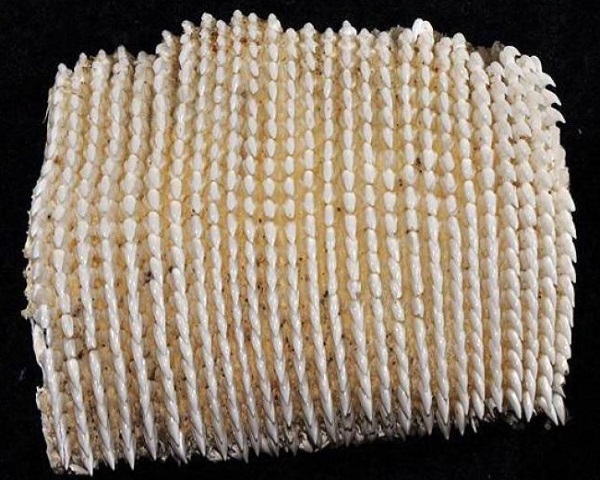
Other reports have detailed whale sharks hovering at the ocean’s surface and waiting for schooling small fish like sardines to, unintentionally, jump straight into their mouth. Footage released earlier this year (2023) also shows them scouring the seafloor, possibly foraging for isopods. But with any newly discovered behaviour, further study is needed to fully understand how it works and why the animal does it. For all we know, this could have been a one-off behaviour from an unusually ambitious whale shark. What is clear though, is that this species can adapt to the situation and experiment with new strategies to catch prey that may have been beyond their reach.
Whale sharks also boast some beautifully distinctive patterns of white spots that can be found in fully grown adults as well as partially developed embryos, as found in a specimen trawled from the Gulf of Mexico in 1953. The patterns are also unique to each individual and allows us to identify them photographs and record repeated encounters. Combined with the previously mentioned methods for measuring their size, we can (if we haven’t already) gain a wealth of information about the whale sharks of the world and work out how fast they grow and where they go at different stages in their life.
Studying such large sea creatures in their natural environment is always going to be a long and laborious process. Sometimes it can be made easier by having the perfect equipment for the job, or encountering an individual bearing some very distinctive markings or scars. But nothing can change the fact that they are wild animals with minds of their own and this rarely correlates with giving researchers exactly what they want. But it’s also important that we try, because the abundance of whale sharks (and other large filter feeders) tells us a lot about the abundance of the plankton they feed on and, by extension, the health of the ocean around them.
From a human perspective
A long time ago, I was travelling by train, I can’t remember where to, or where from, but I do remember a couple, a man and a woman, sitting opposite to me discussing whether a whale shark is a shark or a whale. The woman decided to ask me for my opinion and I confirmed that it was a species of shark. And once I’d revealed that this stranger they had involved was a marine biology student at Plymouth university, the debate was settled instantly. I’m telling you this now because it’s easy to see where the confusion had come from. As well as the name “whale shark”, these animals are as large as some whales and attract just as much awe and fascination.
In some parts of the world, there are people who have developed a warm familiarity with whale sharks and treat them in a similar way that we might treat a local neighbourhood cat. There are villages around Cendrawasih Bay, Papua, Indonesia, where these enormous fish will happily approach the local fishing boats and rub their bodies against them as an apparent show of affection. This is often reciprocated with offerings of fish while local swimmers are known to approach the shark with no fear whatsoever. In fact, their appearance is believed to be a sign of good luck and they are called “gurano babintang”, which means ‘sharks that have stars’ in the local dialect. And this is just one example of sharks ingratiating themselves into our history and culture by simply existing.

A- In the Marshall Islands, tribes would go to war if someone disrespected their sacred shark. In 2011, the Islands’ territories included the world’s largest shark sanctuary.
B- In Papua New Guinea, it’s believed that sharks are the embodiments of their ancestors.
C- Oppian, a Greco-Roman poet who lived in the 2nd century AD spoke of blue shark who supposedly hid their young in their mouths or wombs to hide them from danger.
D- In the Solomon Islands, they believed in sharks who would help fishermen and swimmers, but would also offer human sacrifices to appease them.
E- A tale from Zanzibar tells of a monkey who dreamt of swimming in the seas. He gets a ride on a shark’s back before the shark then tells of his intentions to eat the monkey’s heart. The monkey outwits the shark by claiming he left his heart back on the land.
F- In Tlingit society, sharks and ravens are intertwined in both mythology and family hierarchies. How exactly a given tribe interprets this can be reflected in objects like crests or ‘dance rattles’.
G- Ancient Mayan sites have included fossilised megalodon shark teeth amongst the burial offerings.
H- In Hawaiian mythology there are nine shark gods and goddess. One such goddess was Ka’ahupahau, who once ordered the death of a local girl over an insult. But Ka’ahupahau later regretted her actions and declared that no shark should ever attack a human in the area that is now known as Pearl Harbour.
Where there is a charming accord between people and nature, there are also those from further afield who are willing to see or experience it for themselves. This can be big business with some countries, like the Philippines and the Maldives, where you can find whale sharks printed on banknotes. On the surface, this seems to be a win-win scenario with local communities getting an economic boost along with a vested interest in keeping the sharks out of shark-fin soup.
Alas, there can be ethical issues associated with shark ecotourism, especially in cases where tour operators get too close to the animals or try to entice them closer with food. Even if this doesn’t cause the shark to hurt themselves during the encounter, the disruption to their natural behaviour can lead to subtle, but long term harm. This may not be the intention of the operator, or the tourists who pay them, but ignorance is something to watch out for in any enterprise that involves live animals.

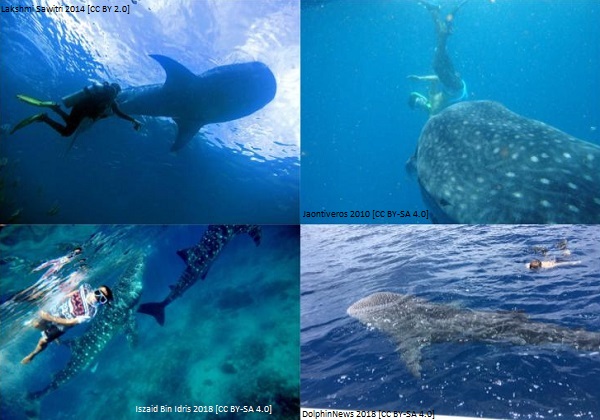
But there is guidance out there, in the scientific literature and from organisations like the Shark Trust and the World Wildlife Fund (WWF), to encourage responsible shark ecotourism. For tourists, this advice can be as straightforward as researching the tour operator and looking out for things like their ethical practices (a dedicated page on their website is probably a good sign) and other indicators. The right information about whale shark behaviours and migration patterns can also help like-minded operators to avoid collisions and unintentional harassment of the animals. Sometimes, it can be as simple as adhering to a minimum distance that will keep people happy and keep the sharks from trying to swim away.

I’m certain there are people out there who would see the whole practice banned, and that would be a fair opinion based on the issues that can arise. But where would that leave the sharks? If you would indulge me in a moment of cynicism, humans will make money from whale sharks in one way or another. Ecotourism is not a perfect solution, but it’s the best we have for keeping that balance between conservation and making a living from this particular natural resource. And at least it shows that, in principle, there is more value in a shark than a piece of meat.

Sources
World Wildlife Fund. WHALE SHARK. https://www.worldwildlife.org/species/whale-shark. Last accessed 25/10/2023
Osterloff. Whale sharks: Meet the world’s biggest shark. https://www.nhm.ac.uk/discover/whale-sharks-worlds-biggest-shark.html. Last accessed 02/10/2023
Shark Trust. 2022. CREATURE FEATURE: WHALE SHARK. https://www.sharktrust.org/Blog/creaturefeature-whale-shark. Last accessed 02/10/2023
IUCN Red List. 2016. Whale Shark. https://www.iucnredlist.org/species/19488/2365291. Last accessed 02/10/2023
Wikipedia. 2023. Whale shark. https://en.wikipedia.org/wiki/Whale_shark. Last accessed 02/10/2023
McClain. 2015. Sizing ocean giants: patterns of intraspecific size variation in marine megafauna
Stevens. 2007. Whale shark (Rhincodon typus) biology and ecology: A review of the primary literature
Gudger. 1941. The food and feeding habits of the whale shark, Rhineodon typus
Taylor. 2007. Ram filter-feeding and nocturnal feeding of whale sharks (Rhincodon typus) at Ningaloo Reef, Western Australia
Britiannica. Ovoviviparity. https://www.britannica.com/science/viviparity. Last accessed 22/10/2023
Garrick. 1964. Additional information on the morphology of an embryo whale shark
Graham and Roberts. 2007. Assessing the size, growth rate and structure of a seasonal population of whale sharks (Rhincodon typus Smith 1828) using conventional tagging and photo identification
Rohner et al. 2015. Laser photogrammetry improves size and demographic estimates for whale sharks
Wildbook for Sharks photo-identification library. HOW IT WORKS. https://www.sharkbook.ai/. Last accessed 25/10/2023
Freedman. 2023. Watch 1st-ever footage of whale shark eating from the bottom of the ocean. https://www.livescience.com/animals/sharks/watch-1st-ever-footage-of-whale-shark-eating-from-the-bottom-of-the-ocean. Last accessed 11/10/2023
Anderson. 2023. Whale Sharks Can Be Indicator Species. https://obdk.com/blogs/obdk-blog/whale-sharks-can-be-indicator-species. Last accessed 25/10/2023
Putri. 2017. These Fishermen in Indonesia Have a Heartwarming Relationship With Whale Sharks. https://theculturetrip.com/asia/indonesia/articles/these-fishermen-in-indonesia-have-a-heartwarming-relationship-with-whale-sharks. Last accessed 25/11/2023
Chen. 2017. Before sharks became movie villains, they were celebrated in myths across the world / Fear and fascination. https://www.theverge.com/2017/7/26/15998676/sharks-myths-history-culture. Last accessed 05/12/2023
Pew. 2011. World’s Largest Shark Sanctuary Declared in Central Pacific. https://www.pewtrusts.org/en/about/news-room/press-releases-and-statements/2011/10/02/worldand39s-largest-shark-sanctuary-declared-in-central-pacific. Last accessed 05/12/2023
Baughman. 1948. Sharks, sawfishes, and rays: their folklore
Wikipedia. 2023. Oppian. https://en.wikipedia.org/wiki/Oppian. Last accessed 05/12/2023
Irvine. 2020. The Monkey and the Shark: An African Folk Tale. https://www.wmoda.com/the-monkey-and-the-shark-an-african-folk-tale/. Last accessed 05/12/2023
Bruchac and Holmes. 2018. Tlingit Raven Rattle: Transformative Representations. https://www.penn.museum/blog/museum/tlingit-raven-rattle-transformative-representations/. Last accessed 10/12/2023
Metcalfe. 2016. In Photos: How Ancient Sharks and ‘Sea Monsters’ Inspired Mayan Myths. https://www.livescience.com/57110-megalodon-sharks-maya-myths-photos.html. Last accessed 10/12/2023
Cruising Indonesia. 2023. Where to find whale sharks Indonesia 2023. https://cruisingindonesia.com/news/where-to-find-whale-sharks-in-indonesia. Last accessed 25/11/2023
Oslob whale sharks. Are you looking for a unique swimming experience with WHALE SHARKS with LESS HASSLE from booking to entire trip? https://www.oslobwhalesharks.com/. Last access 16/12/2023
Recio. Oslob Cebu Travel Guide: More Than Just Whale Sharks. https://guidetothephilippines.ph/articles/ultimate-guides/oslob-cebu-travel-guide. Last accessed 16/12/2023
Shark Trust. Experience Sharks. https://www.sharktrust.org/pages/category/experience-sharks. Last accessed 02/10/2023
Ziegler et al. 2018. A guilty pleasure: Tourist perspectives on the ethics of feeding whale sharks in Oslob, Philippines
Pierce et al. 2010. Developing a Code of Conduct for whale shark interactions in Mozambique
Australian Government: Department of Climate Change, Energy, the Environment and Water. 2021. CITES identification manual Whale Shark. https://www.dcceew.gov.au/environment/marine/publications/cites-identification-manual-whale-shark-rhincodon-typus-smith-1829-characteristics#:~:text=The%20colour%20of%20whale%20sharks,has%20a%20light%20white%20colouration. Last accessed 25/10/2023
Wildlife Trusts. Basking shark. https://www.wildlifetrusts.org/wildlife-explorer/marine/fish-including-sharks-skates-and-rays/basking-shark. Last accessed 16/12/2023
Shark Trust. BASKING SHARK CODE OF CONDUCT. https://www.sharktrust.org/Handlers/Download.ashx?IDMF=6137b1a1-8518-4327-9922-7b280acb8336. Last accessed 16/12/2023
Image sources
Fotografía propia tomada en Maldivas. 2018. [CC BY 4.0 (https://creativecommons.org/licenses/by/4.0)]. https://commons.wikimedia.org/wiki/File:Rhincodon_typus_.png
Feefiona123. 2014. [CC BY-SA 4.0 (https://creativecommons.org/licenses/by-sa/4.0)]. https://commons.wikimedia.org/wiki/File:Whale_Shark_and_Freediver.jpg
Arturo de Frias Marques. 2013. [CC BY-SA 4.0 (https://creativecommons.org/licenses/by-sa/4.0)]. https://commons.wikimedia.org/wiki/File:Whale_Shark_1_AdF.jpg
Jaontiveros. 2010. [CC BY-SA 4.0 (https://creativecommons.org/licenses/by-sa/4.0)]. https://commons.wikimedia.org/wiki/File:Branquias_de_tibur%C3%B3n_ballena.JPG
Jun V Lao Paparazsea. 2016 [CC BY-SA 4.0 (https://creativecommons.org/licenses/by-sa/4.0)]. https://commons.wikimedia.org/wiki/File:Whaleshark_in_Oslob_Philippines.png
Lakshmi Sawitri. 2014. [CC BY 2.0 (https://creativecommons.org/licenses/by/2.0)]. https://commons.wikimedia.org/wiki/File:2014_11_Moalboal_11_Sharkey_and_diver_(16049354522).jpg
Jaontiveros. 2010. [CC BY-SA 4.0 (https://creativecommons.org/licenses/by-sa/4.0)]. https://commons.wikimedia.org/wiki/File:Snorkeling_Whale_shark_3.JPG
Iszaid Bin Idris. 2018. [CC BY-SA 4.0 (https://creativecommons.org/licenses/by-sa/4.0)]. https://commons.wikimedia.org/wiki/File:A_Place_for_Adventure_in_Oslob.jpg
DolphinNews. 2018. [CC BY-SA 4.0 (https://creativecommons.org/licenses/by-sa/4.0)]. https://commons.wikimedia.org/wiki/File:Whale_shark_in_Koh_Chang.jpg
All other images are public domain and do not require attribution.
For more bitesize content and ocean stories why not follow ‘Our world under the waves’ on…
 Our world under the waves


.jpg)


Thanks Matthew . I will alert Meg & Beth to your fb –
<
div>X G
Sent from my iPhone
<
div dir=”ltr”>
<
blockquote type=”cite”>
LikeLike